The framework
One journey, seen from five directions.
DRL describes diagnostic development as a coordinated profile. It asks not only what has been achieved, but which evidence artefacts exist and which stream currently constrains the whole programme.
The readiness rule
The weakest stream is the binding constraint.
A diagnostic project does not become deployment-ready because one dimension is advanced.
Each stream is assessed consecutively. A level is passed only when its defined evidence artefact exists. The overall DRL is the lowest completed level across the five streams, while the full profile preserves the important differences between them.
Four phases
From concept to integration
- 01DRL 1–2
Concept
Is the hypothesis credible, the clinical question clear and the surrounding landscape understood?
- 02DRL 3–7
Development
Can the diagnostic be designed, verified, validated and prepared for authorisation and delivery?
- 03DRL 8–9
Market entry
Can it be authorised, introduced, purchased and used in routine care?
- 04DRL 10–13
Systemic integration
Can it scale, remain effective and contribute to a resilient diagnostics value chain?
Five streams
Development as a profile
- 01
Scientific & Technical
Biological rationale, prototype, analytical performance, manufacturing, scale-up and surveillance.
- 02
Clinical
Clinical question, study design, validity, utility, workflow change and guideline adoption.
- 03
Regulatory & Quality
Quality system, intended use, classification, pathway, submission, authorisation and lifecycle.
- 04
Commercial & Market
Use case, customer discovery, value proposition, business model, reimbursement, distribution and growth.
- 05
Strategic & Systemic
Stakeholders, intellectual property, capital, partnerships, procurement, policy and system integration.
Level architecture
Thirteen levels across four phases
Each cell in the operational instrument corresponds to a gate with a required evidence artefact.
Relationship to other methods
Built alongside, not in place of, established frameworks.
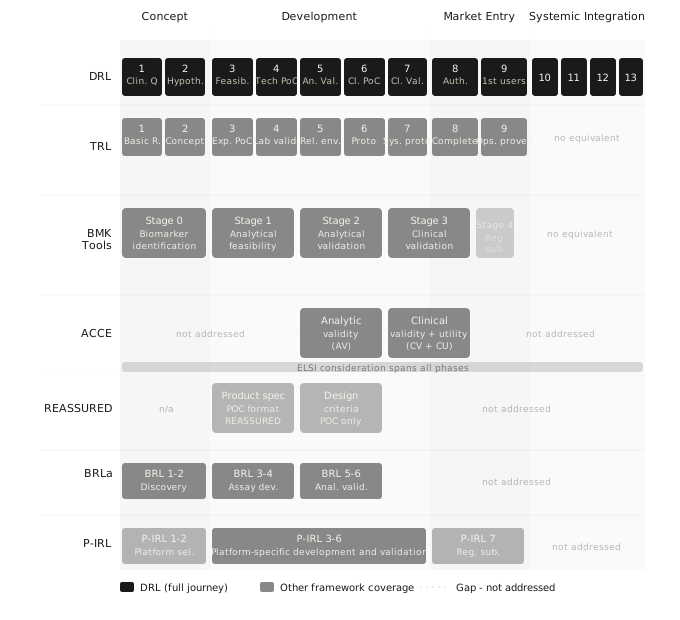
TRL, KTH Innovation Readiness Levels, BMK Tools, ACCE, REASSURED, BRLa and P-IRL each illuminate important parts of innovation or diagnostic development. DRL draws on that landscape while focusing specifically on how five diagnostic-development streams remain coordinated through market entry and system adoption.
It is intended as an organising layer: specialist clinical, regulatory, quality, health-economic and product-development methods remain necessary within it.
Read the v1.0 white paper →